
Lab note · Oct 30, 2026
Fit-test steps must be bigger than the printer's noise
Three lid strips 0.05 mm apart, and the one meant to be loosest felt snuggest. Steps that small can't be told apart by hand.
Everyone prints me, and even I can't feel a 0.05 mm step. Make the steps bigger.
- Step we tried0.05 mm
- Print variationabout 0.1 mm
- Step we use now0.10 mm or more
The question
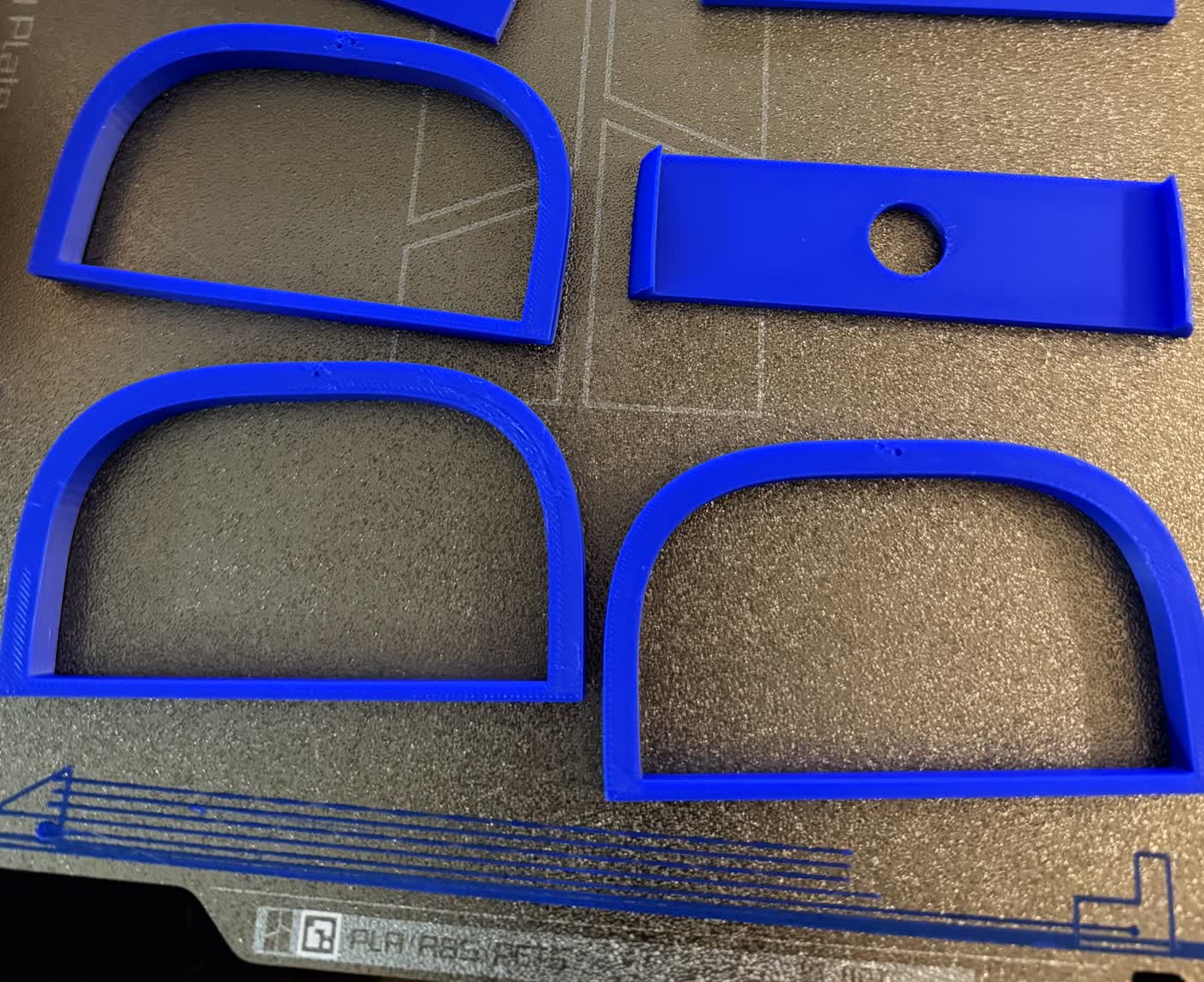
To find the right fit for a box lid, we printed three test strips of the lid's rim, each 0.05 mm different, and marked them with 1, 2 and 3 dots. Could we feel which was which?
What we expected
Each strip pressed a little less into its groove than the one before: 3 dots had no preload at all, so it should have been the loosest.
What happened
All three held. But 3 dots, the one meant to be loosest, felt the snuggest and rattled least. Our best guess: the slightly bigger ramps on the 1- and 2-dot strips perch on a groove that printed a hair low, instead of sitting down in it.
Either way, the strips could not rank a 0.05 mm step: the printer itself varies by about 0.1 mm from print to print and place to place. We went with 3 dots for the lid.
We had seen this before. On our coaster charms, steps of about 0.02 mm put the snuggest charm in the wrong place in the order. The neighbours swap places when the step is smaller than the noise.
What a good test looks like
The same plate had a screen snap test that worked, because it tested something you can feel: does it click in, and can you push it out with a finger? 2 dots did both; 3 dots was too snug.
So now every fit test says, before it is printed, what "right" feels like, and its steps are far enough apart to feel.
| Dots | Preload | Meant to be | What we felt |
|---|---|---|---|
| • | 0.10 mm | Snuggest | Held |
| •• | 0.05 mm | Middle | Held |
| ••• | 0.00 mm | Loosest | Held, rattled least: felt snuggest |
What we do now
- Space fit-test steps at least 0.10 mm apart.
- If you need smaller steps, test the feature that really changes (how far a snap reaches), not the gap alone.
- Write down what "right" feels like before printing: clicks in, holds upside down, comes out with a finger.
- Mark every variant with dots, and test the real joint in its real print orientation.